
All right, I admit it. It’s a bit of a mouthful.
And it’s perhaps harder to spell than is wise for a blog name. It might bring to mind seventh day adventists (I’m not one!)
So why call my blog ‘EighthDayTheology’?
Because of the dazzling hope of what’s to come, which has already started to break in to our present!
It’s a statement of the not-yet which has exploded into our now; the eternal king’s power and promise at work amongst this world’s poverty and problems, pointing to his coming kingdom. The hope of resurrection. Eternal life. A new creation.
But let’s start at the beginning. This is a theology blog. Where do we see the eighth day in the Bible’s story?
The seven day cycle of the old creation
The first chapter of Genesis gives a rich description of God’s utter power over and distinction from his creation. Genesis 1 in particular gives a beautiful account of the order and wisdom in God’s work of creation.
The six creation days of Genesis 1 can be split into two groups based on God’s two main activities: forming spaces through separation, then filling those spaces.
| Forming / separating | Filling |
| Day 1 (Sunday): light and darkness | Day 4 (Wed): Sun, moon and stars |
| Day 2 (Monday): sky and sea | Day 5 (Thursday): birds and fish |
| Day 3 (Tuesday): land and plants | Day 6 (Friday): animals and people |
Then on the seventh day (Saturday), God rests from his work of creating.
Seven represents completeness and perfection, and ever since the beginning, time has ticked on in a countless series of seven day weeks. Not that God’s work of creation restarts every Sunday! But the pattern keeps jumping back to its beginning – we’re ‘locked in’ to the original creation, as it were.
Now that was fine as long as everything was ‘very good’. But it became a big problem when our creation was deformed and cursed by Adam and Eve’s sin.
A glimmer of hope came through God’s promise that one of Eve’s offpring would crush the serpent’s head (Genesis 3:15). To see that promise become reality, Eve and her daughters would have to give birth to children, patiently waiting for that chosen offspring who would stamp on evil once and for all, and perhaps even undo the curse of death.
Which brings us to the first eighth day in Scripture…
The eighth day snip
The first occurence of an eighth day is intimately connected to God’s covenant with Abraham.
You shall be circumcised in the flesh of your foreskins, and it shall be a sign of the covenant between me and you. He who is eight days old among you shall be circumcised.
Genesis 17:11-12a (ESV)
Circumcision was the sign of being included in God’s covenant promise. It marked boys out as God’s chosen people, through whom he would bless the nations. For us, the significant thing is that Israelite boys would live their first week normally, but then on the first day of a new week, they would go through this ceremony to be marked out as people of the promise given to Abraham, the father of faith.
The eighth day was special, because it marked the beginning of something new – God’s promise to Abraham becoming reality one child at a time.
Eight people in the ark
For us New Testament believers, there’s now a new covenant to enter into. Instead of circumcision, we have baptism as the sign of our entry into the covenant – the church’s recognition of our faith and new birth.
Passing through the waters of baptism is a picture of our own personal exodus, escaping slavery to sin and Satan, and emerging through the waters of judgment into the promise of rest in the land that is coming down from heaven.
So it’s interesting to trace the symbolic roots of baptism back to Noah’s flood, and to notice that as well as all the pairs of animals and birds on board the ark, there were… guess how many people? Right. Eight invididuals (Gen 7:7).
Eight people representing a new beginning for the human race. Eight people whose faith in God led them to take shelter from the waters of judgment in the ark. Eight people who would emerge into a new world, wiped (however temporarily!) clean of sin and wickedness.
The New Testament makes the connection between baptism and Noah’s flood.
…when God’s patience waited in the days of Noah, while the ark was being prepared, in which a few, that is, eight persons, were brought safely through water. 21 Baptism, which corresponds to this, now saves you, not as a removal of dirt from the body but as an appeal to God for a good conscience, through the resurrection of Jesus Christ…
1 Peter 3:20a-21 (ESV)
Our baptism is also a sign of a new start – more than that – of our regeneration. Our new birth, into a new life, cleansed of sin through faith in Jesus. It reminds us that on the other side of the wilderness of this life, there is a promised land which awaits us… and God will be there.
Interestingly enough, the early church also made the connection between baptism and the number eight. Octagonal baptismal pools are recorded as early as the 4th or 5th Century, and became fairly standard in the middle ages.
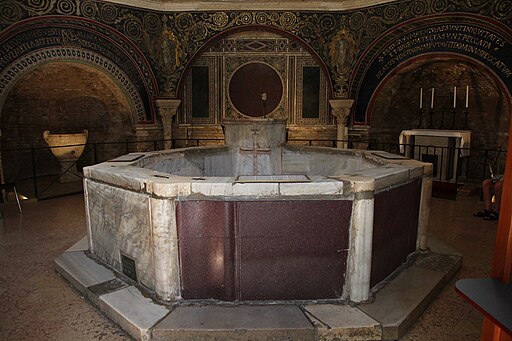
Photo by Gianni Careddu
Eight and resurrection in the early church
Writing in roughly the same time as the Neon baptistry was being built, here’s Augustine on the significance of the eighth day.
If, in reading Genesis, you search the record of the seven days, you will find that there was no evening of the seventh day, which signified that the rest of which it was a type was eternal. The life originally bestowed was not eternal, because man sinned; but the final rest, of which the seventh day was an emblem, is eternal, and hence the eighth day also will have eternal blessedness, because that rest, being eternal, is taken up by the eighth day, not destroyed by it; for if it were thus destroyed, it would not be eternal. Accordingly the eighth day, which is the first day of the week, represents to us that original life, not taken away, but made eternal...
Wherefore, although the sacramental import of the 8th number, as signifying the resurrection, was by no means concealed from the holy men of old who were filled with the spirit of prophecy… nevertheless before the resurrection of the Lord, it was reserved and hidden… because before that event there was indeed the repose of the dead (of which the Sabbath rest was a type), but there was not any instance of the resurrection of one who, rising from the dead, was no more to die, and over whom death should no longer have dominion; this being done in order that, from the time when such a resurrection did take place in the Lord’s own body (the Head of the Church being the first to experience that which His body, the Church, expects at the end of time), the day upon which He rose, the eighth day namely (which is the same with the first of the week), should begin to be observed as the Lord’s day.
Augustine of Hippo, Letter 55, chapters 9, 13This isn’t the place for an exhaustive study of the symbolism of numbers in the early church (for more on that, try Ian Paul’s blog post). I quote Augustine here as a good example of a respected church father finding the same connection between the number eight and the resurrection.
Other eights
Back to the Bible. To sample the rest of the Old Testament at a sprint:
- On the eighth day of Aaron’s consecration, he offered sacrifices for himself and the people, and the glory of the Lord appeared to all the people – the inauguration of his priesthood (Leviticus 9:1, 23)
- After seven days of cleansing, it is on the eighth day that a person may offer their sacrifice and be declared clean (e.g. Leviticus 14:10, 20)
- David, the king after God’s own heart, who is a type of the King to come, was the eighth son of Jesse (1 Samuel 17:12)
- Josiah, the reforming king of Judah who did so much to restore proper worship (2 Kings 23:25), began to reign in his eighth year (2 Kings 22:1)
- When Hezekiah ordered the priests to cleanse the neglected temple, on the eighth day they reached the entrance to the temple itself, and then after a further eight days, the work of consecration was finished, and the temple was fit for purpose again (2 Chronicles 29:17)
Because God is the author of history as well as the divine author of Scripture, he is able to write details like the number eight into the actual historical detail of the lives of these real individuals, and ensure they are recorded to bless us.
Through the Old Testament, the number eight is the number of promise, of cleansing, and of new beginnings. But it’s only when we get to Jesus that we see it’s true significance – resurrection and new creation.
The eighth day in the life of Jesus
It’s significant that Jesus rose on the first day of the week. All four Gospels stress this, and John mentions it twice (Matt 28:1; Mark 16:2; Luke 24:1; John 20:1, 19).
Jesus’s resurrection happens the day after the seventh day. Timewise, we’re both back to the first day of the old creation week, and breaking new ground into a new week of new creation. Resurrection day is the eighth day, and it continues on and on into eternity.
This corresponds to the situation we now find ourselves in. On the one hand, we’re still cycling round the seven days of the old creation. The world is broken and bruised, sin-stained. However, we’re also living in the new age. The age of forgiveness, cleansing, resurrection, and life. An eighth day has come, breaking into the old creation, with the promise of a glorious and blessed future.
It’s no accident that the setting for the resurrection is a garden (John 19:41). When she sees the risen Jesus, Mary Magdalene famously assumes he is the gardener (John 20:15). On this great ‘eighth day’ of new creation, it’s almost like we’re taken back to a second garden of Eden. There’s a promise of perfection restored. And the new man, the head of humanity, Jesus, after he has ascended to his Father, will return to claim his bride.
After eights?
What does all of this mean for us?
There’s one more event which happened on that same resurrection eighth day, which John wants us to know about.
19 On the evening of that day, the first day of the week, the doors being locked where the disciples were for fear of the Jews, Jesus came and stood among them and said to them, “Peace be with you.” 20 When he had said this, he showed them his hands and his side. Then the disciples were glad when they saw the Lord. 21 Jesus said to them again, “Peace be with you. As the Father has sent me, even so I am sending you.” 22 And when he had said this, he breathed on them and said to them, “Receive the Holy Spirit. 23 If you forgive the sins of any, they are forgiven them; if you withhold forgiveness from any, it is withheld.”
John 20:19-23
Our response to the eighth day is the same as it was for those first disciples:
- We too are sent to the world in Jesus’s name, with the incredible news of his resurrection
- We also receive the Holy Spirit, to empower us for this mission
- We too call people to repentance, for the forgiveness of their sins, and the hope of eternal life, through Jesus
We proclaim all this every week, when we gather as God’s people on the Lord’s Day – resurrection day. Then we go out with the good news to a world which needs to hear about the resurrection and experience its power.
What’s in a logo?
If you’ve been squinting at the black and white logo in the top left corner, here it is full size and in glorious technicolour:

I suppose explaining a logo is a bit like explaining a joke – you shouldn’t have to!
Hopefully you can spot an empty tomb for the resurrection, a glorious globe for the new creation, and a number eight. And yes, I know there’s not supposed to be any sea in the new creation, but have you ever tried designing a sea-less globe icon?!
 EighthDayTheology
.jpg)
Leave a comment